
 1 day ago
1
1 day ago
1
ARTICLE AD BOX
Last Updated:May 20, 2026, 08:34 IST
More than 10,000 people were killed. Bangladeshi historians later described the cries of the wounded and dying as turning Chuknagar into a living hell.


Within four to five hours, one of the largest genocides in Asian history — compressed into an extraordinarily short span of time — was carried out on the banks of the Bhadra River in Chuknagar.
Today is May 20. It is not just another date on the calendar, but a reminder of one of the largest single-day massacres of the 1971 war — an atrocity that can be described as a genocide carried out by Pakistan against thousands of Hindu and Muslim civilians, most of them Hindus fleeing towards India through Chuknagar village in Khulna district, in what is today Bangladesh.
WHAT HAPPENED ON MAY 20, 1971?
It was Thursday, May 20, 1971, around 10 am. In the vast open fields of Chuknagar, thousands of marginalised, lower-income Hindu villagers had gathered. Some were cooking food. Mothers were breastfeeding infants. From there, they planned to walk toward the border and cross into India to save their lives. In groups, they moved in different directions.
These vulnerable people had stopped in Chuknagar after exhausting journeys through the darkness of night. Preparations were underway to cross the border. Then news of the refugee movement reached Pakistani army camps in Jessore and Satkhira. Military forces were dispatched with rifles and ammunition.
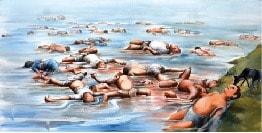
Within moments, horrific bloodshed and screams engulfed the area. More than 10,000 people were killed. Bangladeshi historians later described the cries of the wounded and dying as turning Chuknagar into a living hell.
Within four to five hours, one of the largest genocides in Asian history — compressed into an extraordinarily short span of time — was carried out on the banks of the Bhadra River in Chuknagar. The Bhadra still carries the memory of that brutality.
This bloody massacre along the banks of the Bhadra River remains largely unknown internationally, allowing Pakistan to largely escape accountability in global discourse.
‘THE RIVER TURNED RED’
Kazi Saiful Islam is now a 76-year-old man living in Bangladesh. But when the Pakistan-perpetrated genocide unfolded, he was a graduate student. His father was the Superintendent of Police in Jessore.
“When things went out of hand and the Pakistan Army moved in during late April, my father shifted the family to Chuknagar village. We lived there for a month. We could see refugees fleeing to India and resting on the banks of the Bhadra River, cooking meals before continuing their journey," he tells News18.
On the day of the genocide, he was not present at the scene — otherwise, he says, he would likely not have survived to tell the story.
“But I could hear the gunshots," he recalls. “The next morning, I walked up to the riverbank. I saw endless corpses, either scattered across the shore or floating in the river. I immediately retreated."
Shafikul Islam, a Bangladesh-based researcher who has spent decades painstakingly documenting the massacre and bringing it into public discourse, also witnessed the aftermath.
“I had heard people say that water turned red with blood. On May 21 — a day after the genocide — I saw it with my own eyes. Ponds were filled with dead bodies and the water had turned deep red," he tells News18.
But the scale of the genocide is perhaps best understood through his lived experience rather than his research.
“For nearly fifteen days after May 20, dead bodies — mostly of our Hindu brothers and sisters who were killed — kept floating in with the tides. The stench spread across the area, forcing many families to temporarily relocate. We too had to leave. We returned only after the smell subsided," he says.
WHY CHUKNAGAR WAS TARGETED
Chuknagar was targeted primarily because of its geographical location, the importance of its river routes, and the massive concentration of refugees gathered there at that time.
In May 1971, as Pakistani military operations and killings intensified, large numbers of people from southwestern Bengal began fleeing towards the Indian border to save their lives. Refugees from Jessore, Khulna, Satkhira, Narail, and Bagerhat arrived in Chuknagar through both river and road routes. The village had become a major junction on the path towards India.
Chuknagar was also an important river-based commercial hub. The busy market and river port centered around the Bhadra River had long served as a focal point for trade and movement. As a result, thousands of people gathered there within a short period — most of them unarmed civilians.
At the time, the Pakistani military was strategically targeting places where large groups of civilians had assembled or where they believed freedom fighters could receive assistance, shelter, or escape routes. There was also a broader objective: to spread terror, depopulate areas, crush civilian morale, and eliminate populations attempting to flee toward the border.
Those gathered in Chuknagar were ordinary people trying to survive — women, children, the elderly, farmers, daily wage labourers, and traders. Many were cooking food, some were resting, while others prepared for the next stage of their journey that night. It was at this moment of extreme vulnerability that the Pakistani Army, aided by collaborators such as the Razakars and Al-Badr, launched the massacre.
This was not merely a military operation. It was a horrifying example of terror, brutality, and human catastrophe. Chuknagar was targeted because it was a critical hub along the route of refuge and escape — and for that very reason, it became one of the darkest killing fields in modern history.
The majority of the victims were Bangladeshi Hindus, though many Muslims were also killed in the massacre.
Even today, the Bhadra River is haunted by the memory of lives violently interrupted. If nothing else, Chuknagar deserves a place in international public discourse and historical remembrance.
Handpicked stories, in your inbox
A newsletter with the best of our journalism
News world Remembering The 1971 Genocide: 55 Years Since Pakistan Killed 10,000 Refugees In Chuknagar
Disclaimer: Comments reflect users’ views, not News18’s. Please keep discussions respectful and constructive. Abusive, defamatory, or illegal comments will be removed. News18 may disable any comment at its discretion. By posting, you agree to our Terms of Use and Privacy Policy.
Read More





 English (US) ·