
 10 months ago
15
10 months ago
15
ARTICLE AD BOX
Last Updated:June 26, 2025, 15:10 IST
Swiss scientists have created a 3D-printable ‘living’ building material using algae that stores CO₂ as oxygen, sugars, and minerals, offering a sustainable way to reduce emissions

Swiss scientists develop new 'living' material (Image credit: Yifan Cui & Dalia Dranseike / ETH Zürich)
Imagine walls that don’t just stand still but actively clean the air around them. Swiss researchers have turned this vision into reality by developing a groundbreaking ‘living’ building material that absorbs carbon dioxide (CO₂) from the atmosphere.
This innovative substance is created using blue-green algae (cyanobacteria), which convert CO₂ into oxygen and sugars through photosynthesis. Under specific nutrient conditions, it can also turn CO₂ into sturdy, eco-friendly construction components and solid minerals such as limestone, providing permanent carbon storage while strengthening the material. This breakthrough could revolutionise how we build our cities, making structures that help fight climate change while standing strong.
How Does The ‘Living’ Building Material Work?
The material is based on a 3D-printable hydrogel, a gel-like substance rich in water. Scientists have engineered a porous structure within the hydrogel, allowing light, water, and CO₂ to penetrate freely, keeping the algae active. The cyanobacteria absorb CO₂ from the air and store it in two ways:
- As biomass, where the growing algae retain CO₂ within themselves.
- As carbonate minerals, where CO₂ is stored permanently, reinforcing the material.
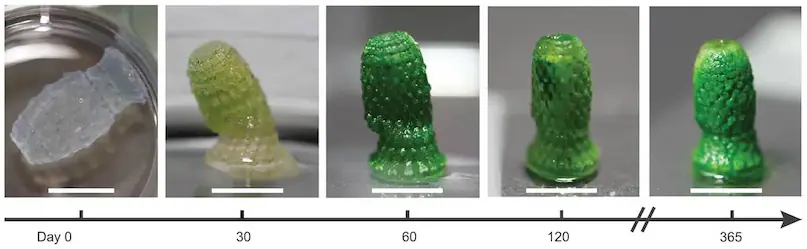
Over a 400-day study, the material continually absorbed CO₂, storing roughly 26 milligrams of CO₂ in solid form per gram of material. While algae growth slows after 30 days, CO₂ absorption does not stop entirely, as mineral accumulation continues over time.
What Could This Mean For Future Building Design?
Scientists envisage this material being applied as a coating on building walls, enabling structures to absorb atmospheric CO₂ and help reduce carbon emissions.
At an architecture exhibition in Venice, Italy, ETH Zurich researchers displayed the material in shapes resembling tree trunks. It is estimated to absorb about 18 kg (40 pounds) of CO₂ annually — comparable to a 20-year-old pine tree.
Can This Technology Be Enhanced?
Researchers believe that by genetically engineering the cyanobacteria to boost their photosynthetic ability, the material’s efficiency can be improved further. Additionally, progress is being made in nutrient delivery systems to help the material sustain itself and remain effective over longer periods.
- Location :
Switzerland
- First Published:
News world Scientists Create ‘Living’ Material That Sucks Carbon Dioxide From The Air







 English (US) ·