
 6 hours ago
2
6 hours ago
2
ARTICLE AD BOX
Last Updated:February 02, 2026, 15:07 IST
New satellite data shows Tibet’s plates flow like a liquid. India-Eurasia collision pushes eastern Tibet eastward by up to 25 mm per year

The Tibetan plateau spans approximately 2.5 million square kilometers with an average height of over 4,500 meters, touching the borders of India, Pakistan, Nepal, Bhutan, and China.
Tibet, long known as the ‘roof of the world’, is revealing surprising and potentially alarming geological behaviour beneath its surface. Recent satellite-based research is challenging long-held tectonic theories, showing that the crust under Tibet behaves less like solid rock and more like a slowly flowing liquid.
This discovery is crucial for understanding future earthquake risks in the region.
Satellites Reveal Unexpected Plate Movements
Scientists used high-resolution maps from the Copernicus ‘Sentinel-1’ satellite to track movements across the Tibetan plateau. They found that:
- The eastern part of Tibet is moving eastward at about 25 millimetres per year.
- Other areas are moving more slowly, at roughly 10 millimetres per year.
This discrepancy indicates that the massive plates are stretching and pressing against each other, challenging the idea that continents are composed of rigid, unyielding blocks.
The Kunlun Fault: Weaker Than Expected
One of the most startling findings involves the Kunlun Fault, which is significantly weaker than previously thought. This weakness allows the interior of Tibet to flow eastward, letting energy from the collision between the Indian and Eurasian plates escape through this softer path.
As a result, the plateau’s structure breaks and spreads internally, rather than behaving as a solid, unyielding mass.
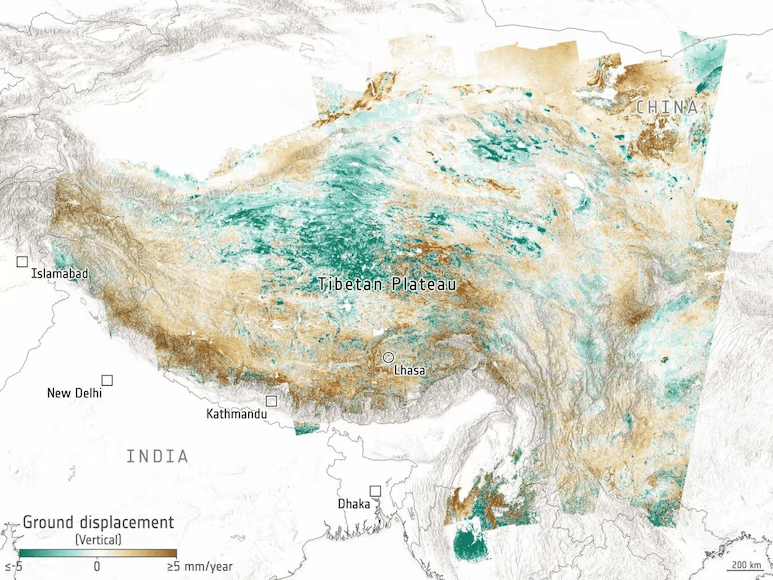
Lead researcher Tim Wright describes this as the clearest depiction yet of how a continent reshapes under extreme tectonic pressure.
Flowing Rocks Challenge Plate Tectonic Theory
Earlier models portrayed the Tibetan plateau as a mosaic of rigid blocks separated by major fault lines. The new study, however, shows that the crust is slowly flowing, a behavior not fully explained by standard plate tectonic theory.
This finding suggests that old models of continental deformation and structure need recalibration.
Scale And Impact Of Tibet’s Movements
The Tibetan plateau spans approximately 2.5 million square kilometers with an average height of over 4,500 meters, touching the borders of India, Pakistan, Nepal, Bhutan, and China.
As the largest continental collision zone on Earth, even small movements here could have serious implications for Asia.
Satellite data reveals vertical movements:
- Certain regions are sinking by 5 millimeters.
- Others are rising by 5 millimeters.
These subtle shifts may indicate areas prone to major earthquakes in the future.
Unprecedented Dataset Enables Millimeter-Precision Mapping
For this research, scientists analysed:
- Over 44,000 radar images
- More than 14,000 GNSS (Global Navigation Satellite System) measurements
This allowed them to create a velocity map accurate to the millimeter, providing the largest geodetic dataset ever compiled for a continental-scale study.
Experts from the European Space Agency (ESA) emphasise that this data could improve earthquake risk models, enhance disaster preparedness, and help keep communities across Asia safer.
Handpicked stories, in your inbox
A newsletter with the best of our journalism
First Published:
February 02, 2026, 15:07 IST
News world Tibetan Plateau In Motion: Asia’s Map Could Change Due To Plate Collision
Disclaimer: Comments reflect users’ views, not News18’s. Please keep discussions respectful and constructive. Abusive, defamatory, or illegal comments will be removed. News18 may disable any comment at its discretion. By posting, you agree to our Terms of Use and Privacy Policy.
Read More







 English (US) ·