
 7 hours ago
2
7 hours ago
2
ARTICLE AD BOX
Powered by:
Last Updated:May 18, 2026, 16:04 IST
Launched in 2013, Tinder changed the online dating landscape with its now-iconic swipe feature- swipe right to express interest and left to pass.


Business of Apps data shows Hinge’s revenue climbing sharply after 2021, even as growth across several competing platforms began to slow (Reuters image used for representation)
After years of explosive expansion, the global dating app industry is beginning to show signs of fatigue as users increasingly move away from swipe-based platforms and revenue growth starts to slow.
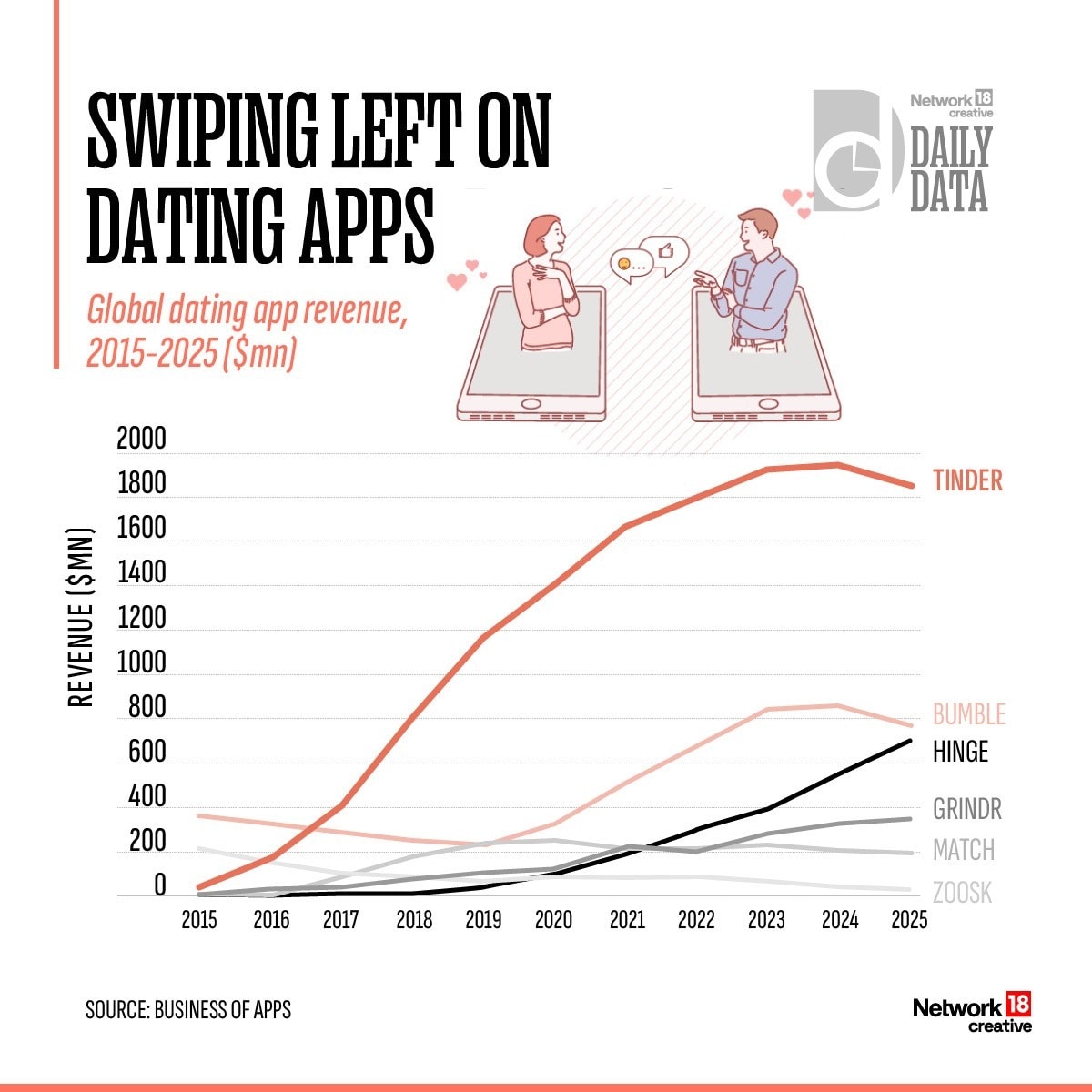
Data tracking the global revenue trends of leading dating apps between 2015 and 2025 shows that while platforms such as Tinder, Bumble and Hinge continue to generate billions, growth has moderated significantly in recent years.
Figures compiled by Business of Apps show Tinder continuing to dominate the market as the world’s highest-earning dating platform. However, after years of sharp growth, the app’s revenue appears to have stabilised and even declined slightly in 2025.
The Swipe Revolution That Reshaped Online Dating
Launched in 2013, Tinder changed the online dating landscape with its now-iconic swipe feature- swipe right to express interest and left to pass. The simple format transformed digital dating by replacing lengthy profiles and compatibility-based matchmaking systems with quick, mobile-first interactions.
Developed by Hatch Labs and backed by IAC, Tinder rapidly emerged as the dominant player in the industry, overtaking older platforms such as Match.com and OKCupid, both of which were also owned by IAC.
Its rise fundamentally altered how people approached online relationships and helped popularise app-based dating across the world.
Bumble And Hinge Offered A Different Approach
As Tinder grew, competing platforms sought to distinguish themselves with alternative models and user experiences.
Bumble, co-founded by former Tinder executive Whitney Wolfe Herd, gained traction by introducing a women-first messaging system in heterosexual matches.
Meanwhile, Hinge positioned itself as a platform focused on meaningful and long-term relationships rather than casual interactions. That strategy appears to have resonated with users, with Hinge emerging as one of the fastest-growing apps in recent years.
Business of Apps data shows Hinge’s revenue climbing sharply after 2021, even as growth across several competing platforms began to slow.
A Multi-Billion-Dollar Industry
Despite growing signs of user fatigue, dating apps continue to represent a massive global business.
According to Business of Apps, the dating app industry generated more than $6 billion in revenue in 2025. Nearly $3.3 billion of that came from Match Group, which owns Tinder, Hinge and several other platforms.
More than 350 million people around the world currently use dating apps, with close to 23 million paying for premium features such as profile boosts, unlimited swipes and advanced filters.
Tinder also remained the most downloaded dating app globally in 2025, followed by Bumble.
Changing User Behaviour
Industry analysts say many users are becoming increasingly frustrated with swipe-heavy dating culture, expensive subscription models and the difficulty of forming meaningful connections on large platforms.
The shift in user behaviour has also created space for niche platforms such as Pure, Feeld and Boo, which cater to specific interests and communities rather than broad, mass-market matchmaking.
More than a decade after Tinder introduced the swipe, the industry it helped build remains enormous — but its era of rapid growth may finally be beginning to slow.
Handpicked stories, in your inbox
A newsletter with the best of our journalism
News tech Tinder To Hinge: Swipe Left Moment For Dating Apps As Users Pull Back
Disclaimer: Comments reflect users’ views, not News18’s. Please keep discussions respectful and constructive. Abusive, defamatory, or illegal comments will be removed. News18 may disable any comment at its discretion. By posting, you agree to our Terms of Use and Privacy Policy.
Read More





 English (US) ·