
 9 months ago
18
9 months ago
18
ARTICLE AD BOX
A possible prisoner exchange is underway that could return to Venezuela hundreds of migrants and asylum-seekers whom President Donald Trump sent to one of the most notorious prisons in El Salvador, news outlets reported Friday.
The exchange would swap Venezuelans being held in Centro de Confinamiento del Terrorismo, or CECOT, for Americans being held prisoner in Venezuela.
The Venezuelans in CECOT were sent there by the Trump administration for indefinite imprisonment on the United States’ behalf — without charge, trial or sentencing. Rather, they were punished for having attempted to come to the United States. Many followed legal pathways. About half were accused of being “alien enemies” under the Alien Enemies Act, meaning the Trump administration claimed, largely without evidence, they were not only gang members but akin to members of an invading army.
Bloomberg and Reuters first reported on the potential exchange Friday, both citing unnamed sources.
Reuters cited one official who said the deal would involve 238 Venezuelans in CECOT in exchange for five U.S. citizens and five U.S. permanent residents. Bloomberg reported the number at “roughly 250 Venezuelans” and said Venezuela’s information ministry “summoned journalists to the airport early on Friday.” Venezuelan outlet La Patilla similarly reported that Venezuelan President Nicolás Maduro had agreed to a prisoner swap, citing unnamed sources.
Michelle Brané, a former U.S. government immigration official who is now executive director of the group Together and Free, which has worked with many families of CECOT detainees, said the group had heard from several of those families who were on their way to Caracas after hearing from Venezuelan government officials.
Venezuelan government officials have told families “there was an exchange happening, and their loved ones were coming home,” Brané told HuffPost in a brief phone call Friday, describing what some families told Together and Free.
“Mothers that got calls are on their way to Caracas,” Brané said. “[The Venezuelan government] called some families. They said that they weren’t calling everybody, so they were sort of creating a phone tree.”
“At least one family confirmed that the government confirmed to her that her son was on the plane,” Brané said, noting that a case manager at Together and Free had spoken to the family in question.
The mother of one of the Venezuelan CECOT detainees sent HuffPost footage of a bus full of detainee family members en route to Caracas.
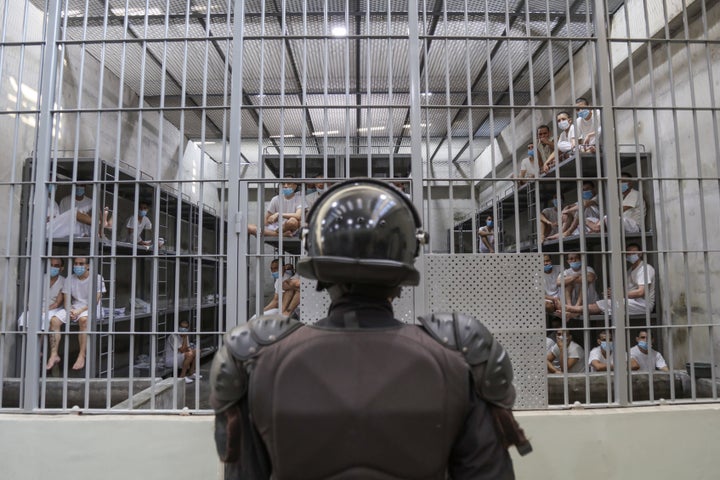
Alex Peña via Getty Images
Many of the CECOT detainees were Venezuelans seeking asylum in the U.S. because of fear of violence or persecution back home. Some had pending asylum cases in U.S. immigration court when the Trump administration disappeared them to the Salvadoran prison. ProPublica reported Friday, based on a case-by-case analysis of over 230 of the Venezuelan men sent to El Salvador, that “most of the men were not hiding from [U.S.] authorities but were instead moving through the nation’s immigration system” and that “more than 60 of them had pending asylum claims, including several who were only days away from a hearing where a judge could have ruled on whether they would be allowed to stay.”
The departments of State and Homeland Security did not immediately respond to HuffPost’s inquiry about how they determined who would be included in the swap and whether they had sought safety protections for those who had previously fled Venezuela.
CECOT is known for allegations of torture and inhumane treatment, and has been used to jail tens of thousands of Salvadorans. Salvadoran President — and self-described “world’s coolest dictator” — Nayib Bukele has governed under a “state of exception,” in which constitutional due process guarantees have been suspended and human rights advocates and journalists have been targeted by the Salvadoran government.
Kilmar Abrego Garcia, a Maryland man from El Salvador who was sent to CECOT based on an “administrative error,” described in a recent court filing being beaten, kicked and subjected to psychological abuse while in the megaprison. Abrego Garcia was returned to the U.S. last month, months after the Supreme Court ordered the U.S. government to facilitate his return — though the Trump administration brought him back to purportedly face criminal charges for allegedly transporting unauthorized migrants within the U.S. He has pleaded not guilty.
Previous prisoner swap negotiations fell through, in part because of competing efforts by Secretary of State Marco Rubio and Trump’s envoy to Venezuela, Richard Grenell, The New York Times reported last week. While Rubio was working on a deal to free Americans held in Venezuela in exchange for about 250 Venezuelan migrants the U.S. had sent to El Salvador, Grenell was pursuing a separate deal in which Venezuela would release American prisoners in exchange for allowing Chevron to continue operating in Venezuela.
The White House has repeatedly claimed it does not have authority over the people it sent to CECOT, despite paying the Salvadoran government millions of dollars to detain non-U.S. citizens. Salvadoran officials have told the United Nations High Commissioner for Human Rights’ Working Group on Enforced or Involuntary Disappearances that “the jurisdiction and legal responsibility for these [Venezuelan detainees in CECOT] lie exclusively with the competent foreign authorities, by virtue of international agreements signed and in accordance with the principles of sovereignty and international cooperation in criminal matters.”
Prisoner swap negotiations suggest the Trump administration does indeed have control over those imprisoned in CECOT — and has opted to use them as political bargaining chips.
It’s unclear exactly how many Venezuelans the Trump administration has sent to Salvadoran prisons. Neither the U.S. nor Salvadoran governments have released a full list of detainees, and the governments’ refusal to acknowledge the detainees, combined with the detainees’ ongoing imprisonment in an unconfirmed location, has led human rights experts to call the detentions “enforced disappearances.”
When the first detainees were transferred in March, CBS News published an internal government list of 238 names of Venezuelan detainees who had been flown to El Salvador. Subsequent transfers brought the number up to 252 Venezuelans in Salvadoran detention, with 36 additional known Salvadoran immigrants to the United States who were transferred to CECOT.
20 Years OfFreeJournalism
Your Support Fuels Our Mission
Your Support Fuels Our Mission
For two decades, HuffPost has been fearless, unflinching, and relentless in pursuit of the truth. Support our mission to keep us around for the next 20 — we can't do this without you.
We remain committed to providing you with the unflinching, fact-based journalism everyone deserves.
Thank you again for your support along the way. We’re truly grateful for readers like you! Your initial support helped get us here and bolstered our newsroom, which kept us strong during uncertain times. Now as we continue, we need your help more than ever. We hope you will join us once again.
We remain committed to providing you with the unflinching, fact-based journalism everyone deserves.
Thank you again for your support along the way. We’re truly grateful for readers like you! Your initial support helped get us here and bolstered our newsroom, which kept us strong during uncertain times. Now as we continue, we need your help more than ever. We hope you will join us once again.
Already contributed? Log in to hide these messages.
But 404 Media, reporting on hacked material from an Immigration and Customs Enforcement aviation contractor, reported Thursday: “The flight manifests for three legally contested deportation flights from Texas to El Salvador contain dozens of additional, unaccounted for passengers than a previously published Department of Homeland Security (DHS) list of people deported from the United States on those flights.” The outlet published the additional names it had reviewed.



 English (US) ·